
Introduction
Success in academics does not always depend on intelligence alone. In many cases, students perform better because they follow the best study techniques consistently. Good study habits improve concentration, reduce stress, and help learners understand topics more clearly. Whether you are preparing for school exams, college assignments, or professional certifications, using effective methods can completely change your learning experience.
Many students spend long hours studying but still struggle to remember information. This usually happens because they rely on passive reading instead of active learning. The best study techniques encourage students to interact with information, practice regularly, and organize their study time wisely. As a result, learning becomes easier and more enjoyable.
Modern education also requires students to manage distractions, balance responsibilities, and maintain motivation. With proper planning and smart strategies, students can study efficiently without feeling overwhelmed. The right techniques not only improve grades but also build confidence and self discipline.
This guide explains the best study techniques for beginners and intermediate learners. It includes practical methods, examples, benefits, common mistakes, expert advice, and answers to frequently asked questions. By applying these strategies regularly, students can improve academic performance and develop skills that support lifelong learning.
What is Best Study Techniques?
Best study techniques are proven methods that help students learn information effectively, remember concepts for longer periods, and improve academic performance. These strategies involve active learning, time management, revision planning, note taking, and concentration improvement.
Instead of studying randomly, students use structured approaches to understand and retain information. Examples include active recall, spaced repetition, mind mapping, summarization, and practice testing. Each technique focuses on making learning more organized and efficient.
Different students prefer different methods depending on their learning style. Some understand topics better through visuals, while others learn through writing, discussion, or practical exercises. The goal is to find techniques that increase productivity and make studying less stressful.
The best study techniques also encourage consistency. Studying for short periods every day is usually more effective than last minute cramming before exams. With proper techniques, students can improve focus, reduce procrastination, and achieve better results.
Why is Best Study Techniques Important?
Effective study methods are important because they save time and improve learning quality. Students who follow the best study techniques often understand subjects faster and retain information for longer periods.
These techniques also reduce academic pressure. Instead of feeling confused before exams, students become more confident because they have prepared properly. Organized study habits help learners avoid panic and manage deadlines smoothly.
Another reason study techniques matter is that they improve memory. Active learning methods train the brain to process and recall information more effectively. This makes it easier to answer exam questions and complete assignments accurately.
Good study strategies also support personal development. Students become disciplined, responsible, and motivated. They learn how to manage time, set goals, and maintain productivity in different areas of life.
In addition, proper study techniques help students maintain balance. They can study efficiently while still making time for hobbies, exercise, and relaxation. This creates a healthier academic lifestyle and prevents burnout.
Detailed Step by Step Guide
Set Clear Study Goals
Every successful study session begins with a clear goal. Students should decide what they want to achieve before opening books or notes.
For example, instead of saying “I will study science,” set a specific target such as “I will complete chapter three and solve five practice questions.” Clear goals improve focus and motivation.
Writing goals in a notebook or planner also helps students stay organized. Short term goals create a sense of achievement and encourage consistent learning habits.
Create a Study Schedule
A proper study schedule helps students manage time effectively. It prevents last minute stress and ensures that every subject receives enough attention.
Students should divide study time into smaller sessions with short breaks in between. This approach improves concentration and reduces mental fatigue.
For example, many students use the fifty minute study method followed by a ten minute break. A balanced schedule also includes sleep, meals, exercise, and relaxation.
Choose a Comfortable Study Environment
The study environment affects concentration and productivity. Students should choose a quiet, clean, and organized place for learning.
Good lighting and comfortable seating can improve focus during long study sessions. Keeping phones and unnecessary distractions away is also important.
Some students prefer complete silence, while others focus better with soft background music. Experimenting with different environments can help identify the best setting.
Use Active Recall
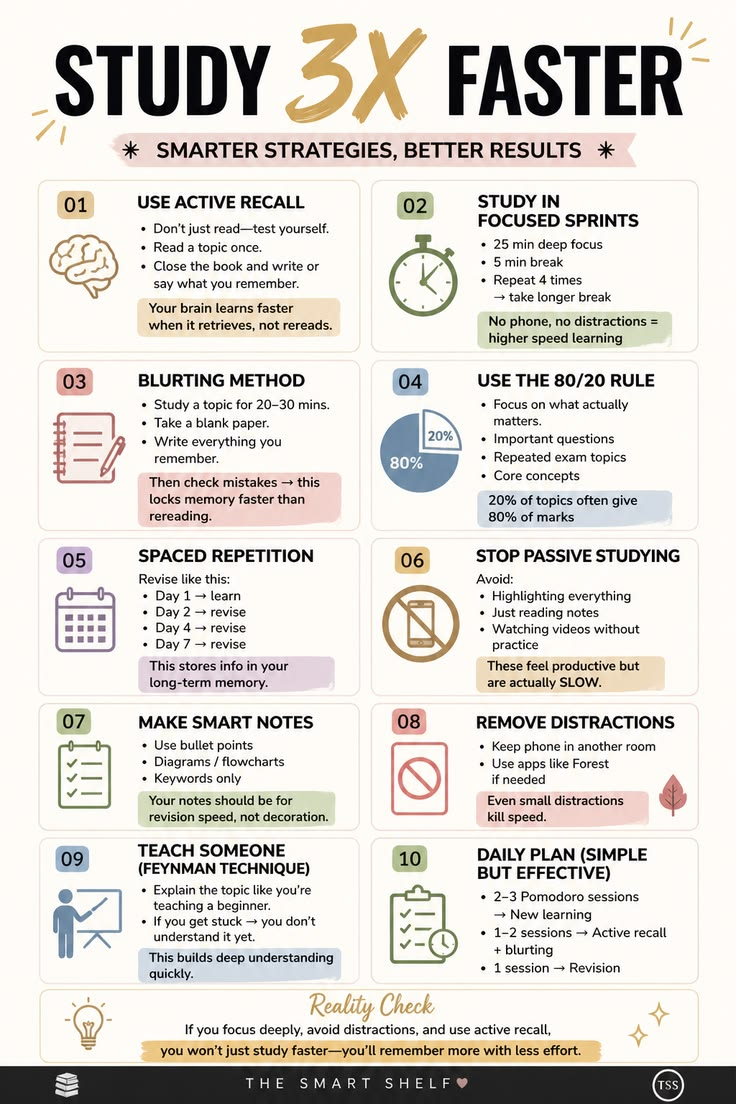
Active recall is one of the best study techniques for improving memory. Instead of rereading notes repeatedly, students test themselves on what they learned.
For example, after reading a chapter, close the book and try to explain the topic from memory. This strengthens understanding and helps information stay in the brain longer.
Flashcards, quizzes, and practice questions are useful tools for active recall. Students who use this technique regularly often perform better in exams.
Practice Spaced Repetition
Spaced repetition involves reviewing information at regular intervals instead of studying everything in one session.
For example, students can revise a topic one day after learning it, then again after three days, one week, and two weeks. This method improves long term memory.
Spaced repetition reduces forgetting and makes revision more effective. It is especially useful for subjects that require memorization, such as biology, history, and languages.
Take Smart Notes
Good notes make revision easier and save time during exams. Students should focus on important ideas instead of writing every word from textbooks.
Using headings, bullet points, and keywords improves note organization. Highlighting important information can also help during revision.
Methods like the Cornell note taking system or mind mapping are useful for organizing concepts clearly. Well prepared notes improve understanding and reduce confusion.
Avoid Multitasking
Many students believe multitasking increases productivity, but it usually reduces concentration. Studying while checking social media or watching videos makes learning less effective.
Focusing on one task at a time improves comprehension and memory. Students should complete one topic before moving to another.
Turning off notifications and using study timers can help maintain attention. A distraction free approach improves study quality significantly.
Practice with Mock Tests
Mock tests are excellent for exam preparation. They help students understand question patterns and improve time management skills.
Practicing under exam conditions also reduces nervousness. Students become familiar with pressure and learn how to answer questions efficiently.
After completing a mock test, reviewing mistakes is important. Identifying weak areas allows students to improve before the actual exam.
Teach Others What You Learn
Teaching is one of the most powerful learning methods. When students explain concepts to others, they understand topics more deeply.
For example, explaining a math formula to a friend helps strengthen understanding. Teaching also reveals knowledge gaps that need improvement.
Students can teach classmates, siblings, or even explain topics aloud to themselves. This technique improves confidence and communication skills.
Maintain Healthy Habits
Physical and mental health directly affect academic performance. Students should eat balanced meals, drink enough water, and sleep properly.
Regular exercise improves brain function and reduces stress. Even short walks can refresh the mind during study breaks.
Proper sleep is especially important because memory consolidation happens during rest. Students who sleep well usually focus better and learn faster.
Benefits of Best Study Techniques
The best study techniques offer several advantages for students of different ages and academic levels.
- Improve concentration and focus
- Increase memory retention
- Reduce exam stress and anxiety
- Help students manage time effectively
- Encourage consistent learning habits
- Improve confidence during tests
- Support better academic performance
- Reduce procrastination
- Make learning more organized
- Promote self discipline and responsibility
Students who follow effective methods often feel more motivated and prepared. They also develop problem solving and critical thinking skills that are useful beyond academics.
Disadvantages and Risks
Although the best study techniques are highly effective, students may face certain challenges while applying them.
- Some techniques require patience and consistency
- Students may feel frustrated when results take time
- Strict schedules can become stressful if not balanced
- Overplanning may reduce flexibility
- Excessive studying can lead to burnout
- Comparing study methods with others may create pressure
- Using too many techniques at once can cause confusion
To avoid these risks, students should choose techniques that match their learning style and maintain a healthy balance between study and relaxation.
Common Mistakes to Avoid
Many students make mistakes that reduce study effectiveness. Avoiding these habits can improve learning outcomes significantly.
One common mistake is cramming before exams. Last minute studying often causes stress and weak memory retention. Instead, students should revise regularly throughout the semester.
Another mistake is studying without breaks. Long sessions can reduce concentration and increase mental fatigue. Short breaks improve productivity and refresh the mind.
Many learners also ignore sleep while preparing for exams. Lack of sleep affects memory, focus, and decision making. Proper rest is essential for effective learning.
Studying in distracting environments is another major issue. Noise, mobile phones, and social media interrupt concentration and waste valuable time.
Some students spend too much time highlighting textbooks without understanding concepts. Passive reading is less effective than active learning methods such as self testing and summarization.
Finally, students often avoid asking for help. Discussing problems with teachers, classmates, or tutors can improve understanding and prevent confusion from increasing.
FAQs
What are the best study techniques for exam preparation?
The best study techniques for exams include active recall, spaced repetition, mock testing, and smart note taking. These methods improve memory and understanding while reducing stress during preparation.
How many hours should students study daily?
Study time depends on academic goals and difficulty levels. Most students benefit from two to five focused hours daily with proper breaks and consistent revision.
Is studying at night better than studying in the morning?
Some students focus better at night, while others learn more effectively in the morning. The best time depends on personal energy levels and concentration patterns.
How can students improve concentration while studying?
Students can improve concentration by removing distractions, setting clear goals, taking short breaks, and following a structured study schedule. Healthy sleep and exercise also improve focus.
Why is active recall considered effective?
Active recall strengthens memory because students actively retrieve information instead of reading passively. This process improves understanding and long term retention.
Can study techniques help reduce exam anxiety?
Yes, proper study techniques reduce anxiety by improving preparation and confidence. Students who revise regularly usually feel calmer and more prepared during exams.
Expert Tips and Bonus Points
Students can improve results further by applying a few additional strategies consistently.
Start difficult subjects when energy levels are highest. Most students focus better during the first study session of the day.
Use productivity tools such as planners, calendars, or study apps to organize tasks and deadlines effectively.
Reward yourself after completing study goals. Small rewards can increase motivation and make studying feel less stressful.
Study in groups occasionally for discussions and idea sharing. However, ensure the group remains focused and productive.
Review mistakes carefully instead of ignoring them. Learning from errors is one of the fastest ways to improve academic performance.
Stay positive during difficult subjects. Consistent practice often turns weak areas into strengths over time.
Reading beyond textbooks can also improve understanding. Educational articles, documentaries, and practical examples make learning more interesting and engaging.
Most importantly, remember that consistency matters more than perfection. Small daily improvements often create significant long term success.
Build a Consistent Revision Routine
Revision is important because information fades when it is not reviewed regularly. Students who revise weekly usually remember topics more effectively than those who study only before exams.
A simple revision routine can include reviewing class notes every evening and revisiting difficult topics during weekends. This habit keeps concepts fresh in memory and reduces pressure during final exams.
Color coded notes and revision charts can also make reviewing easier. Many students find visual organization helpful for understanding large subjects quickly.
Improve Reading Techniques
Reading effectively is another important part of academic success. Students should avoid reading too quickly without understanding the content.
One useful method is previewing the chapter before studying deeply. Reading headings, summaries, and keywords first creates a better understanding of the topic structure.
Students should also pause after each section and summarize the information in simple words. This method improves comprehension and keeps the mind active during study sessions.
Use Visual Learning Methods
Visual learning techniques help students understand complicated topics more clearly. Charts, diagrams, mind maps, and flowcharts make information easier to remember.
For example, science students often use labeled diagrams to understand biological systems. History students may use timelines to remember important events.
Creating visual summaries can also make revision faster before exams. Students often recall images more easily than large paragraphs of text.
Stay Motivated During Long Study Periods
Motivation is important for maintaining consistent study habits. Many students begin enthusiastically but lose interest after a few weeks.
Setting realistic goals helps maintain enthusiasm. Instead of aiming for perfection immediately, students should focus on gradual progress.
Positive self talk also improves confidence. Encouraging yourself after completing difficult tasks creates a healthier learning mindset.
Listening to motivational speeches, reading inspiring stories, or studying with disciplined friends can also increase determination and consistency.
Learn Time Management Skills
Time management is closely connected with academic success. Students who plan their day properly often complete tasks more efficiently.
Creating a daily priority list helps students identify important tasks first. Difficult subjects should usually be completed before easier ones.
Avoiding procrastination is another important habit. Delaying assignments often increases stress and reduces work quality.
Students should also learn how to balance academics with personal activities. Proper balance prevents exhaustion and improves mental health.
Build Confidence Before Exams
Exam confidence grows through preparation and practice. Students should avoid comparing themselves with classmates because everyone learns differently.
Completing practice questions regularly improves familiarity with exam patterns. This reduces fear and improves answering speed.
Relaxation techniques such as deep breathing can also help students remain calm during tests. Staying positive often improves performance significantly.
Preparing materials one day before exams is another useful habit. Organized preparation reduces unnecessary panic on exam day.
Benefits of Group Study
Group study can be highly effective when managed properly. Students can discuss ideas, solve problems together, and explain concepts to each other.
Different students often have different strengths. One student may understand mathematics well, while another may explain science topics clearly.
Group discussions also improve communication skills and encourage teamwork. However, students should avoid groups that become distracting or unproductive.
Keeping sessions short and goal oriented helps maintain effectiveness during collaborative learning.
Develop Critical Thinking Skills
Critical thinking allows students to analyze information deeply instead of memorizing facts blindly. This skill is important for academic and professional success.
Students can improve critical thinking by asking questions during study sessions. For example, they can ask why a concept works, how it applies in real life, and what problems it solves.
Reading different viewpoints on the same topic also strengthens analytical ability. Students become more open minded and thoughtful learners.
Problem solving activities, debates, and case studies are excellent ways to develop logical reasoning skills.
Additional Frequently Asked Questions
Which study technique is best for memorization?
Spaced repetition and active recall are considered the best techniques for memorization because they strengthen long term memory through repeated practice and review.
How can students stop procrastinating?
Students can reduce procrastination by breaking tasks into smaller goals, removing distractions, and starting with simple tasks to build momentum and motivation.
Are handwritten notes better than digital notes?
Both methods can be effective. Handwritten notes improve memory for many students, while digital notes are easier to organize and edit quickly.
What should students do when they feel mentally tired?

Students should take short breaks, drink water, stretch, or go for a brief walk. Resting the mind improves concentration and prevents burnout.
Is group study better than studying alone?
Both methods have benefits. Independent study improves focus, while group study encourages discussion and idea sharing. A balanced combination often works best.
Successful students understand that learning is a continuous process. They remain curious, practice regularly, and stay patient during challenges. By improving daily habits, students can achieve excellent academic results without unnecessary stress. Effective studying is not about spending endless hours with books. It is about using smart strategies, maintaining discipline, and staying committed to growth.
Conclusion
Developing effective learning habits is one of the most valuable investments students can make. The best study techniques help learners improve focus, manage time, strengthen memory, and perform better in exams. Instead of relying on last minute preparation, students who follow structured methods build confidence and reduce stress.
Every learner is different, so students should experiment with various approaches to discover what works best for them. Techniques such as active recall, spaced repetition, mock testing, and smart note taking can transform the way information is understood and remembered. When combined with healthy habits and proper planning, these strategies create a balanced and productive academic routine.
Consistency is the key to long term improvement. Even small study sessions completed regularly can produce better results than irregular hours of stressful preparation. Students should also remember that progress takes time, and patience is essential while developing new habits.
The journey toward academic success becomes easier when students study smarter instead of harder. By applying the best study techniques regularly, learners can achieve higher grades, improve confidence, and develop valuable life skills that support future personal and professional growth.