
Imagine if each little snack that the child enjoys helped rebuild their strength while playing, laughing, and growing up. It is not just food that satisfies one’s appetite but also supports the growth that is taking place inside his/her body.
Hidden in all the jumping and running activities that children enjoy, there is an interesting process taking place that is muscle repair. Little do people know about this that muscle repair does not need any fancy supplements; it needs good nutrition, and this is exactly where protein-rich snacks for kidsplay an extremely crucial role.
Why Muscle Repair Matters More in Childhood Than Adulthood
Childhood is not a fixed stage in muscle development; it is a building site. Any kind of motion causes minor deterioration within the muscle cells. This is not a form of injury but rather a catalyst for growth in the tissues. It means that the body repairs the muscle cells in a much stronger and more effective manner than before.
From a scientific standpoint, this entire procedure is based on amino acids, which are tiny molecules that are a result of proteins. There are 20 amino acids, but only 9 are deemed crucial since the human body cannot produce these. Scientific research published in nutrition journals indicates that children have a higher turnover of muscle protein than adults due to their growing needs and exercise.
The Hidden Biology Behind Protein and Repair
Protein is not merely “nutrient intake”; protein is a biological instructional mechanism. Once ingested, the protein breaks down to form amino acids, which then circulate within the blood and function as raw materials for:
- Building of muscle fibers
- Synthesis of enzymes
- Regulation of hormones
- Body repair
In this context, an important scientific mechanism is muscle protein synthesis (MPS). The body uses the MPS to rebuild its muscle fibers. Research studies have found that the MPS increases considerably when high-quality protein is continuously consumed.
The ICMR-NIN diet recommends that, on average, 0.85 to 1.2 grams of protein is required by kids daily per kg of body mass, according to their age group, rate of growth, and level of activity.
However, for physically active children who participate in sports, play outdoor games, and engage in other physically demanding activities, the amount of protein increases up to 1.0 to 1.5 grams.
How Protein Quality Shapes Growth Efficiency
Not all protein functions equally in the body because various protein types have different compositions of amino acids, different rates of digestion, and different levels of effectiveness in helping the body repair and build muscles.
- All forms of animal protein provide all essential amino acids in the right proportions.
- Plants lack one or two kinds of amino acids, but can become a complete protein source through appropriate combinations.
The example of this combination is found in the mixture of grains and legumes. This is the reason why combinations such as dal-rice are scientifically sound despite their seeming simplicity. Such combinations have become increasingly vital in modern-day snack products.
Smart Snacking: Turning Everyday Foods Into Growth Support
This is where the field of food science becomes practical. Rather than depending on single nutrients, modern-day nutrition revolves around functional foods. These include:
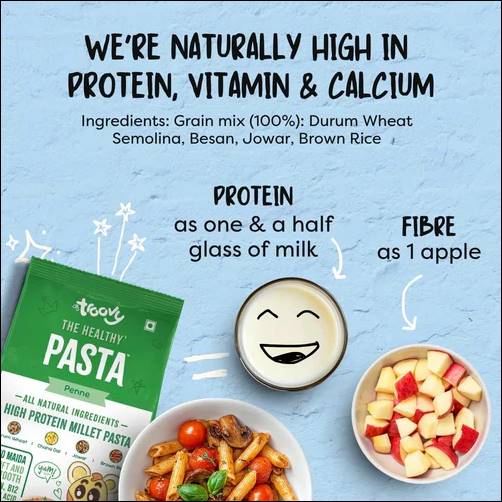
- Pasta made from chickpeas, durum, and millets, which offer slow-burning energy with protein interaction.
- Snacks based on millets, which combine ragi, jowar, and whole wheat in order to deliver continuous nutrition.
- Snacks based on crunch, which use dals and grains for high protein content.
- Moong dal chips contain up to 76% moong dal, combined with urad dal, rice, and sabudana for amino acid balance and crunchy texture.
These are not mere snacks but are structured nutritional systems that promote development and recovery. Even healthy vegan snacks for kids in nature are now carefully formulated by incorporating multiple sources of plant proteins in order to provide complete amino acids without relying on animal products alone.
Protein Timing: The Science Most People Miss
The greatest discoveries about muscle biochemistry are the importance of timing as much as the actual quantity. It is more efficient to take protein throughout the day than all at once in one meal.
In the case of children:
- Breakfast gives energy repair in the mornings.
- Snacks during mid-day keep the amino acids available.
- Dinner provides a complete recovery cycle.
Having proteins continuously will ensure that muscles are not waiting for nutrients to repair themselves. According to statistics, an even distribution of protein can improve the overall muscle biochemistry efficiency by 25%–35%.
The Role of Plant-Based Innovation in Modern Nutrition
Nutrition from plants is not a sacrifice anymore; it is an engineering strength. If wisely blended, plant nutrients can be as efficient as animal proteins while providing extra benefits of fiber and minerals.
Modern science combines plant-based foods in ways such as:
- Millets and pulses to ensure complete amino acid content.
- Seeds and grains for high mineral content.
- Legumes and whole grains for slow nutrient release.
This is precisely why structured formulation of healthy vegan snacks for kids is being scientifically acknowledged, because they provide a range of proteins through food engineering.
From Science to Everyday Plates
What distinguishes the efficiency of proteins from others is their consistency and not their complexity, because the human body needs an even flow of amino acids to maintain health and not occasional and excessive supplies. This point becomes especially valid when dealing with children, who have a constantly developing and repairing muscle system that needs constant feeding.
It is important to emphasize that the child does not need any particular extreme diets; what he needs is a balanced and constant consumption of amino acids throughout his meals and snacks, which will ensure the constant synthesis of proteins in his muscles. This is why it has been considered essential in child nutrition science today to include the incorporation of snack formulas rich in nutrients into regular food habits. Food is no longer just used for hunger satisfaction but as a means of supporting constant growth cycles occurring at a cellular level.
Conclusion: Where Nutrition Meets Real Growth Science
The muscle regeneration process among children is an ongoing biological activity that depends on amino acid consumption, timing, and protein consistency. In the field of nutrition science, the modern-day emphasis is to keep the entire biological process easy, natural, and integrated in every child’s diet.
In such a case, Troovy is one of the innovative brands that are making this idea a reality. The strategy of such brands includes developing practical products that include sugar-free protein powders for kids. This is achieved through plant protein sources, millet, and scientific formulation to develop practical nutrition. The idea is for nutrition to be aligned to the growth of the children while being practical at the same time. The best nutrition strategy today is not about eating but rather how one eats.