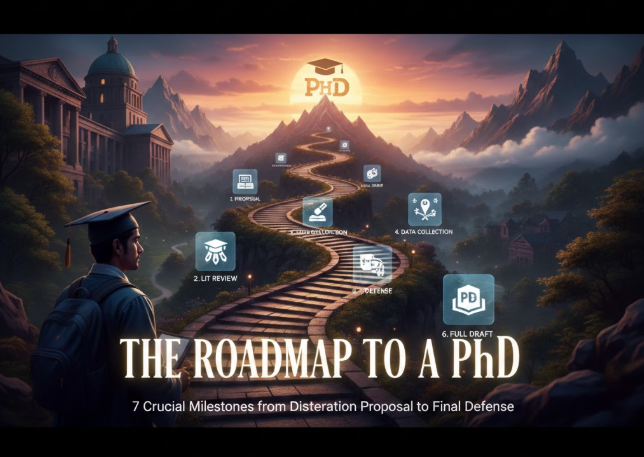

Starting a PhD is a lot like standing at the base of a massive mountain. You know the view from the top will be incredible, but the path up is often hidden by clouds, rocky terrain, and the occasional storm. For most graduate students in the US and abroad, the journey is less about raw brilliance and more about sheer endurance. It is a transition from being a consumer of knowledge to becoming a creator of it. This process is structured around specific milestones that ensure your research is valid, ethical, and significant to your field.
Many students begin their academic careers by seeking basic academic essay help from myassignmenthelp to master their undergraduate writing, but the leap to a PhD requires a much more specialized set of skills. While a standard essay might take a few days, a dissertation is a multi-year commitment that demands a high level of self-discipline. Understanding the roadmap ahead can help you manage the stress and keep your project on track when the workload feels overwhelming.
Milestone 1: The Research Proposal and Committee Selection
The first major hurdle is the dissertation proposal. This isn’t just an outline; it’s a formal document that proves your research is worth doing. You need to identify a “gap” in existing knowledge—something that hasn’t been fully explained or explored yet. Your proposal will typically cover your research questions, a brief look at current literature, and your planned methodology.
Equally important is selecting your committee. These are the faculty members who will guide you, critique you, and eventually decide if you’ve earned your doctorate. You want a mix of personalities: someone who is an expert in your specific niche, someone who is a master of your methodology, and a chair who is known for being supportive but firm. A good relationship with your chair is the single most important factor in finishing on time.
Milestone 2: The Literature Review (The “Deep Dive”)
Once your proposal is approved, you have to prove you know everything there is to know about your topic. The literature review is often the most time-consuming part of the early stages. It involves reading hundreds of journal articles, books, and conference papers. You aren’t just summarizing these works; you are synthesizing them.
You need to show how different studies connect, where they disagree, and how your work fits into the larger conversation. This stage requires incredible organization. Most successful students use citation software like Zotero or Mendeley to keep track of their sources. If you lose track of your citations early on, you will face a nightmare of a task when you try to format your final bibliography.
Milestone 3: The Methodology and IRB Approval
Before you can collect a single piece of data, you must explain exactly how you plan to get it. This is your methodology. Are you doing a quantitative study with thousands of survey responses? Or a qualitative study involving deep-dive interviews with a small group of people? Your methodology must be “replicable,” meaning another researcher could follow your steps and get similar results.
In the US, if your research involves human subjects, you must pass through the Institutional Review Board (IRB). This board checks to make sure your study is ethical and that you aren’t harming your participants. This stage can involve a lot of back-and-forth paperwork, so it’s best to start your IRB application as early as possible.
The complexity of these early stages is why many doctoral candidates look for extra support. It is not uncommon for students to seek out professional dissertation writing services to help them refine their methodology or format their initial drafts according to strict university guidelines. This kind of expert consultation can be the difference between a rejected proposal and a successful start.
Milestone 4: Data Collection (The Fieldwork)
This is the “doing” phase of your PhD. For a scientist, it might mean spending 12 hours a day in a lab. For a social scientist, it might mean traveling to conduct interviews or observing a classroom. For a historian, it involves months in the archives.
Data collection is rarely perfect. Your equipment might break, your survey participants might not show up, or the data might not show what you expected it to show. The key here is to document everything. Every mistake and every unexpected result is actually a data point that could be useful later. Don’t panic if things go wrong; panic if you don’t write down how they went wrong.
Milestone 5: Data Analysis and Results
Once you have your data, you have to make sense of it. This is often where students feel the most “imposter syndrome.” If you’re doing quantitative research, you’ll likely use software like SPSS, R, or Stata to run statistical tests. If you’re doing qualitative research, you might use NVivo to code your interview transcripts for recurring themes.

The goal of the results chapter is to present the facts without bias. You aren’t arguing your point yet; you are simply stating what the data says. If the data disproves your original hypothesis, that’s okay! In fact, some of the most famous breakthroughs in history came from “failed” hypotheses. Accuracy is much more important than being “right.”
Milestone 6: The Full Draft and Formatting
This is the stage where you pull everything together into one cohesive document. A dissertation is usually between 100 and 300 pages long. Writing at this scale is an exercise in project management. You can’t just sit down and write a 200-page book in a week; you have to break it down into small, manageable chunks of 500 to 1,000 words a day.
Pay close attention to your university’s formatting guidelines. Whether they require APA, MLA, or Chicago style, they are usually very strict about margins, font sizes, and citation formats. Many students get their dissertations sent back just because their page numbers were in the wrong corner or their table of contents didn’t match their headings. It’s worth doing a “formatting pass” where you don’t even look at the words, only the layout.
Milestone 7: The Dissertation Defense
The final milestone is the defense. You will stand before your committee and present your research. In some universities, this is a public event; in others, it’s a private meeting. The “defense” isn’t an interrogation, though it can feel like one. It is actually a scholarly conversation.
Your committee will ask you why you chose your methodology, how you handled certain limitations, and what your research means for the future of the field. The best way to prepare is to know your work better than anyone else in the room. By this point, you are the world’s leading expert on your specific dissertation topic. If you can answer their questions with confidence and humility, you will walk out of that room as a Doctor.
Key Takeaways for PhD Success
- Consistency Over Intensity: Writing two hours every day is better than writing 14 hours once a week.
- Seek Feedback Early: Don’t wait until a chapter is “perfect” to show it to your chair. Get feedback on rough drafts to avoid wasting time.
- Manage Your Mental Health: PhD burnout is real. Make sure you have a life outside of your research.
- Use Your Resources: Whether it’s the writing center, your peers, or professional consultation, don’t try to do this entirely alone.
The path to a PhD is long, but it is manageable if you take it one milestone at a time. Each stage—from the proposal to the defense—is designed to help you grow as a scholar. When you finally hold that finished document in your hands, the years of hard work will feel worth it.
Frequently Asked Questions
1. What is the main purpose of a dissertation proposal?
The proposal acts as a formal blueprint for your research. It is designed to prove to your committee that your chosen topic is original, your methodology is sound, and the study can be realistically completed within your timeframe.
2. How long does the dissertation process usually take?
While every student is different, the journey from proposal to defense typically takes between two to five years. This timeline depends on the complexity of your data collection and the number of revisions required by your committee.
3. What is the difference between a thesis and a dissertation?
In the US academic system, a thesis is generally the final project for a Master’s degree, often summarizing existing research. A dissertation is a much more in-depth project required for a PhD that must contribute original knowledge to the field.
4. How should I prepare for a final defense?
The best preparation is to know your data inside and out. Re-read your entire draft, anticipate critical questions about your methodology, and practice explaining your findings clearly to someone who is not an expert in your specific niche.
About the author
Alexander Andeerson is a senior academic consultant with myassignmenthelp, where she specializes in guiding doctoral candidates through the complexities of high-level research and academic publishing.